GROUND (277 words)
Any Point Can Become a Beginning
This essay is both reflection and practice, an attempt to understand how relation itself can be a way of thinking, making, and being. I write from in-between places, where ideas, materials, and experiences meet to grow new thoughts. The reading does not need to follow a single path.
The structure that holds this writing is inspired by the rhizome, as described by Deleuze and Guattari in A Thousand Plateaus (1987). Unlike tree-like hierarchies, the rhizome grows through connection, where any point can become a beginning and multiplicity is maintained rather than resolved into unity (Deleuze & Guattari, 1987, pp. 7, 8, 21). Glissant extends this into an ethics of interconnection in his Poetics of Relation (2025), proposing that relation itself is a poetics(1) – a way of making meaning through encounters.
The notion of syncretism has often been used to describe Brazil’s mixed cultural and spiritual landscape, yet its apparent inclusiveness rests on a colonial logic(2). As Nugent (2015) notes, the rhetoric of cultural fusion served the national project more than it honoured coexistence. Montero (2018) explains that “the political ideology of syncretism produced and organised religious variety by including it hierarchically within the Catholic culture and Brazilian state, thereby undermining the autonomy or visibility of non-Western religious sources” (p. 2). Against this background, I propose relational syncretism as a decolonial framework(3) for coexistence in contemporary Brazilian art. Drawing on Glissant (2025) and Freire (1970), I trace how coexistence thrives not through total understanding or domination but through care, respect, and encounter.
NODE 1 (236 words)
In-betweenness
My journey begins in the in-between: Brazil and the United Kingdom, urban design and art, teaching and learning. This liminal space grounds my practice, where identities shift and knowledge emerges through encounter.
Living across cultures, I have come to see philosophy not as abstraction but as a way of locating myself in relation to others. In this context, empathy emerged as an ethical practice, my attempt to turn a philosophical orientation toward relation into genuine connection. Yet, through this writing, I have begun to question empathy itself: its generosity but also its potential to reduce difference by assuming one can fully know another’s experience. Pedwell (2012) argues that framing empathy as a route to understanding across difference can, in practice, reinforce hierarchies, since privileged subjects’ claims to empathise may appropriate or obscure the voices of the marginalised. When my voice feels out of place, I turn instead to dialogue, not as performance but as a shared search for meaning that allows partial understanding to become relation.
This way of thinking guides my art. Creation, for me, begins in dialogue and grows through relation. As I research relational syncretism, writing and reading becomes another form of making.
The lexicon that emerges across this essay is not fixed vocabulary but living material, shaped through encounters between thinking with ideas, making with materials and being with experience, a rhizome of thought that continues to grow. These terms surface through practice and theory rather than being predetermined. I gather them in the appendices(4) not as definitions, but as an evolving thinking that informs my artistic practice.
ADVENTITIOUS ROOTS (326 words)
Umbanda: A Lived Model of Coexistence
Growing up in Brazil, I was surrounded by the coexistence of multiple cultural traditions and faiths. This plurality was ordinary, though not always officially recognised. In my family home, as in many others, a small domestic altar displayed symbols from different traditions: Catholic saints, African Orixás, protection beads from Candomblé or Umbanda, healing herbs, and lucky charms. These were not daily rituals but reminders of care and belief.
Within this landscape, I first encountered Umbanda, a religion that brings together African, Indigenous, Catholic, and Spiritist cosmologies. The altar, for example, materialises the kind of coexistence I now seek to understand theoretically. A single sacred space holds Catholic saints beside African Orixás, Indigenous caboclos, and Spiritist symbols, each distinct yet sharing the same spiritual field. As Engler notes, “Umbanda exhibits semantic plurality, meaning that wide variation between groups is not subject to normative judgement (Engler 2023, p.311)”.
Even as I turn to Umbanda as a model for thinking relationally, I remain aware that it has been shaped by histories of prejudice and suppression, and that many of its practices continue to be stigmatised in contemporary Brazil (Hale, 2004; Montero, 2018).
During a gira(5), these cosmologies converge through rhythm, gesture, and song, the scent of herbs, the drums, the movement of bodies in white forming what Hale calls a “politics of the senses” (2004, p. 301), where history and spirituality are felt rather than represented. Within this mixture, each tradition retains its integrity, distinct yet belonging together. Umbanda’s power lies not in complete fusion but in coexistence, where difference is activated through proximity. This is relational syncretism: an ethics of coexistence where meaning emerges through relation rather than hierarchy or fusion. Umbanda here exemplifies a broader Brazilian cultural logic of coexistence, where distinct traditions remain in relation (Engler, 2023).
[Image removed due to copyright restrictions]
Image not displayed for copyright reasons. Readers may consult authorised sources for visual documentation of Umbanda rituals.
Through these sensorial and embodied practices, Umbanda offered me an early, lived example of how distinct systems can exist together without erasure. It models a form of empathy grounded in participation and respect, rather than the assumption of sameness, knowledge transmitted through intuition, rhythm, and gesture, rather than through formal instruction. This resonates with Freire’s later emphasis on dialogue and learning through encounter (Freire, 1970). Such sensorial ethics have become foundational to how I understand relation itself.
INTERNODE (279 words)
Dialogical Making
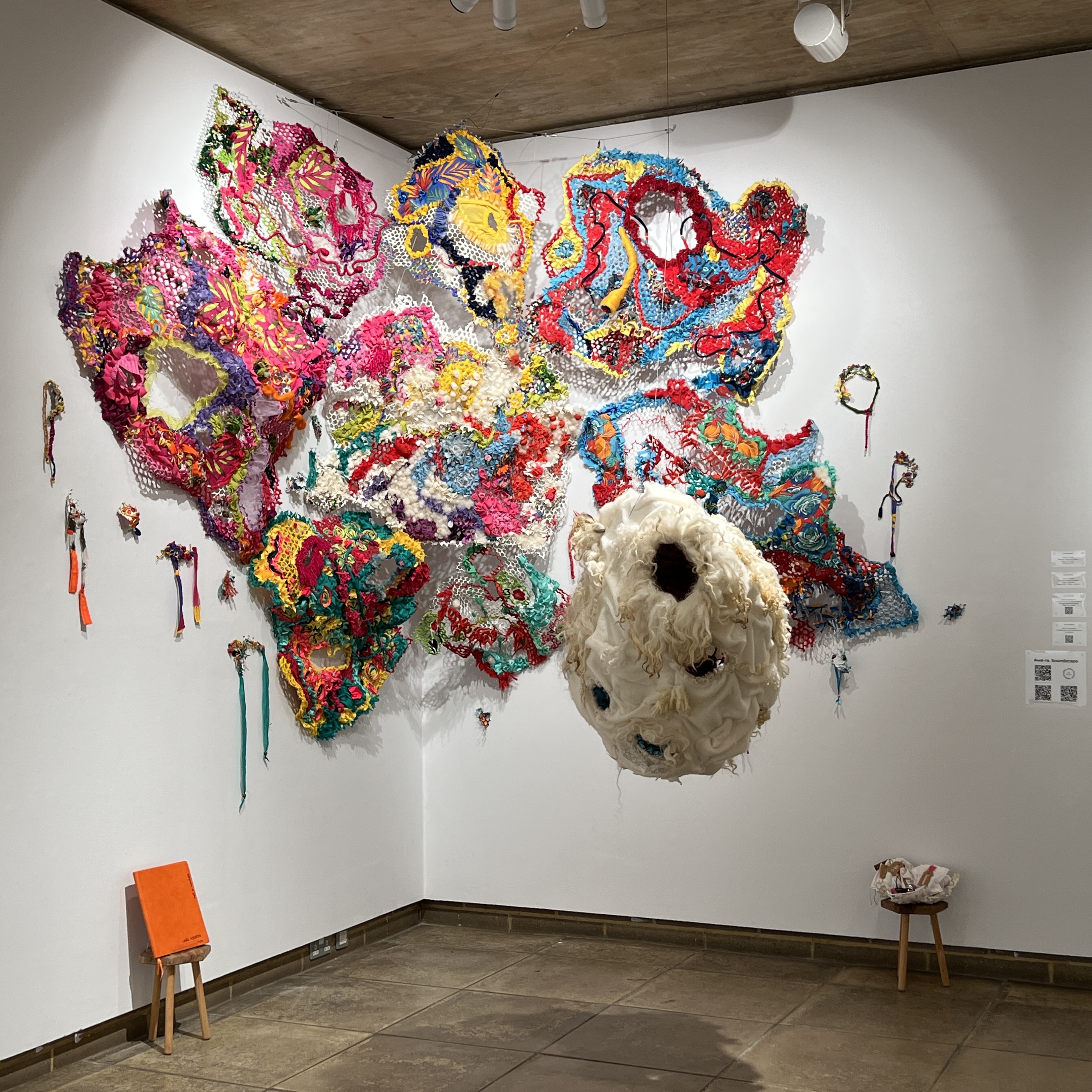
Just as Umbanda’s altar models coexistence, Awe-ra unfolds through dialogical making.
Umbanda's coexistence model led me to understand dialogue as a way of practising relation. I first encountered Paulo Freire (1970) while reflecting on how to position myself as an educator. Years later, creating Awe-ra(6), I returned to his ideas, seeking to let the work grow through dialogue with others. His belief that "dialogue cannot exist without a profound love for the world and for people" (Freire, 1970, p. 89) frames relation as a process that is both generative and transformative. Within this framework, making emerges not from solitude but through encounter.
The work began with an open invitation: I asked people to donate clothes they no longer needed, items carrying stories I would never fully know. Each piece of fabric arrived with its opacity intact. This sense of unknowing became essential. The donated materials became agents of relation, connecting lives through acts of giving without demanding transparency. Working with these textiles meant entering into dialogue with others, even without their physical presence.
Awe-ra is not a finished object but an ever-expanding sculpture that grows through relation. During workshops, participants can add their own garments, extending its form and meaning. Each iteration becomes a new conversation, a living archive of encounters. Leftover materials became wearable art pieces in collaboration with jewellery artist Marina Topouzi and gifted back to participants. This circular exchange, receiving, transforming, returning, enacted Freire's dialogical pedagogy, where no one is merely donor or recipient. Sound designer Eduardo Amaro created a soundscape that interwove traditional Brazilian songs, adding a sonic layer of relation and memory. My home became a site of dialogical making, collapsing the distance between life and work.
NODE 2 (578 words)
Thinking through Relation
In seeking to define relational syncretism, I turned to Paulo Freire (1921–1997) and Édouard Glissant (1928–2011). They lived during overlapping periods and on the same side of the Atlantic and, although there is no evidence of shared publications, their work speaks to shared concerns. Reading Glissant’s Poetics of Relation (2025), I recognised ideas that aligned with Freire’s Pedagogy of the Oppressed (1970). For Glissant, “rhizomatic thought is the principle behind [...] the Poetics of Relation, in which each and every identity is extended through a relationship with the Other” (Glissant, 2025, p. 10). This resonates with my practice, where the identity of each work emerges from relationships among diverse materials and processes. While the result is new meaning, each element contributes its own difference and its own opacity, participating respectfully in transformation.
Exploring how Freire’s dialogical approach might inform Glissant’s poetics, I encountered the concept of the “right to opacity”, which reshaped my understanding of relation. For Glissant, to relate ethically is to respect the other’s opacity: “We demand the right to opacity for everyone” (2025, p. 189). This enables coexistence without hierarchy, allowing meaning to emerge through encounter rather than domination or assimilation.
In Afro-Brazilian cosmologies, Exu embodies a similar tension between knowing and unknowing. Exu inhabits the space between worlds, opening paths but also troubling them. He reminds us that relation is never fully stable or fully knowable. Basquiat’s Exu (1988) visually evokes this unpredictable, transformative energy. Relational syncretism, unlike idealised models of dialogue, acknowledges this instability. It does not promise transparent understanding but accepts that relation moves through opacity, risk and the possibility of misrecognition.
[Image removed due to copyright and cultural sensitivity]
For contextual information about Exu, see the official resources of CONACULTA (Conselho Nacional da Umbanda).
Reading Glissant alongside Freire reveals clear parallels in their ethics of encounter. Both oppose totalising systems of knowledge and advocate mutual transformation through relation. Freire teaches that dialogue depends on humility and love (1970). For Glissant, relation depends on respect and opacity (2025). Together, they offer a framework for coexistence grounded in difference.
Relational syncretism emerges from this pairing as an ethical and aesthetic approach in which connection occurs without erasure and encounter itself generates meaning. This becomes what Glissant calls an “entanglement of diversities” (2025, p. 93), a process through which artistic practice can model coexistence, reciprocity and care.
BUD (624 words)
Artists in Dialogue: A Poetic Lexicon in Practice
Turning to practice, I recognised relational syncretism not as abstract principle but as lived experience: embodied, ethical, transformative. These dimensions, distilled from previous explorations of ritual, relation, and difference, have become anchors in the lexicon emerging through this writing. Relation operates through the body, honours opacity, and generates new meaning through difference.
Embodiment and Experience: Ayrson Heráclito, Buruburu (Popcorn Ceremony) (2011)
Relation begins in the body. In Buruburu, Ayrson Heráclito performs a Candomblé-inspired ritual of purification with popcorn, referencing the healing practices of the Orixá Obaluaê. The tactile sound of popcorn hitting the skin, the whiteness of the grains, and the rhythm of movement create a multisensory experience. Knowledge is transmitted through touch and rhythm, as body and environment merge in reciprocal exchange.
[Image removed pending copyright permission]
Although the gestures are public, their cosmological meaning may remain opaque to outsiders. The sacred is protected while others are invited into an encounter grounded in sensing rather than knowing. The viewer does not need full understanding to sense the cleansing force of the act. Watching Buruburu, I understood how relational syncretism can materialise as texture, rhythm, and care. As Hale describes, a “politics of the senses” can allow healing to emerge from shared gesture rather than explanation (2004).
Ethics of Difference: Rosana Paulino, Parede da Memória (1994)
In Parede da Memória, Rosana Paulino sews together images of anonymous Black women from family and archive photographs, building a wall of memory and repair. Each piece is enclosed in a patuá, a fabric amulet used for protection in Afro-Brazilian tradition.
[Image removed pending copyright permission]
[Image removed pending copyright permission]
Sewing becomes a slow dialogue with ancestors. Each stitch repairs, but does not fully reveal, preserving the opacity of the faces. Viewers cannot completely identify the women, yet partial visibility insists on recognition. This creation of a space between knowing and not knowing enacts Glissant's right to opacity (2025) and Freire's pedagogy of humility (1970). In this approach, relation is built on respect.
Through repetition, fragments of memory become gestures of resilience. Paulino’s work helped me see how relational syncretism can express coexistence through difference and repair through opacity, rather than submitting to the colonial demand for visibility that would make marginalised subjects legible to power.
Processes of Transformation: Elida Tessler, Doador (1999)
In Doador, Elida Tessler invited 270 people to donate common objects whose Portuguese names end with -dor. Each object was displayed with a brass plaque inscribed with the donor’s name. The word doador means “donor,” but also contains dor, meaning “pain.” Tessler’s work brings together generosity and vulnerability, gift and loss.
[Image removed pending copyright permission]
Through the act of giving, ownership becomes relation. Objects keep emotional residue, but new meanings arise through each encounter, enacting Freire’s concept of dialogical pedagogy. The visitor’s presence completes the work, turning viewing into participation.
The objects’ stories remain opaque. Their silence matters; care does not require total knowledge. Doador showed me how meaning can exist in what is not fully known, in the potential for relation that transforms private experience into a shared space while preserving difference.
Synthesis
Together, these works give tangible form to relational syncretism. Heráclito grounds relation in ritual and touch. Paulino weaves repair through opacity. Tessler invites transformation through acts of exchange. Relation is not a fixed concept but a process that connects bodies, materials, and meanings in ongoing renewal. As Glissant suggests, this is an “entanglement of diversities” (2025). Through these artistic encounters, the theoretical framework I have developed finds material life and resonance.
FLOWER (424 words)
No Point is an Ending
Relational syncretism is both poetics and practice: a decolonial framework for thinking about coexistence in contemporary Brazilian art, one that privileges opacity over transparency and reciprocity over hierarchy. Coexistence does not require total understanding but thrives through care, respect, and embodied encounter.
Heráclito showed me that relation begins in the body, that knowledge can be sensory, rhythmic, and shared. Paulino reminded me that repair is about respect for what cannot be fully known, echoing Freire's humility and Glissant's ethics. Tessler revealed that generosity and pain are intertwined, that giving itself can be a form of knowing. Together, these works offer a language for coexistence that honours incompleteness and welcomes uncertainty as a creative condition.
In my own practice, particularly in Awe-ra, I continue to explore these conditions of relation. The work grows through acts of donation and transformation, where each piece of fabric carries a trace of another life. Yet the trickster figure of Exu reminds us that relation is never guaranteed to succeed. Connection moves through opacity, risk, and potential misrecognition. Relational syncretism acknowledges this instability; it does not promise transparent understanding but asks instead for attention, respect, and participation.
This acknowledgment demands self-critique. Relational syncretism carries its own risks. Respecting opacity might inadvertently protect power from being questioned. Celebrating coexistence could romanticize what remains unequal. Even non-hierarchical relations happen within systems that advantage certain voices. Not all opacity is sacred; not all relation is just. The framework I propose must remain self-critical and provisional, recognizing that relation alone does not guarantee equity. What matters is how we remain accountable to the power dynamics that shape every encounter.
The lexicon gathered in the appendix reflects this unfinished quality: not a closed system, but a set of relations that continues to evolve through practice. What began as a search for empathy has become an exploration of coexistence, where understanding is partial and difference keeps relation alive. Like the rhizome that inspired its form, this essay grows through relation rather than hierarchy. Yet growth requires questioning as much as affirming. If any point can become a beginning, then no point can be an ending, including the framework itself.
Relational syncretism endures as both lexicon and practice, yet questions remain: Can this framework travel beyond Brazilian contexts without reproducing the very extractive gestures it critiques? How might other diasporic art practices embody similar principles through different cosmologies? These questions keep the inquiry alive, reminding us that each ending is always another beginning.
APPENDICES
Appendix A — Lexicon of Relational Syncretism
Introduction
This lexicon gathers concepts that emerged through the writing of this essay. They did not exist as predetermined definitions. Each term developed as living material shaped through encounters between theory, lived experience, analysed artworks, cultural memory and my own making process.
Every entry reflects how the concept appears in the essay and how it can guide future artistic practice. It develops from my interpretation of the discourses that I brought together in order to develop the concept of relational syncretism.
Each entry derives from the essay and is structured as:
- Term: the concept
- Appears in: its location within the rhizome structure of the essay
- Concept: a brief description (1–2 lines)
- Practice Orientation: how this term informs or orients artistic making
The terms are grouped by rhizome location. Each entry functions both as a conceptual node in the rhizome and as a seed for the principles presented in Appendix C.
GROUND: Orientation
Rhizome
Appears in: GROUND
Concept: A non-hierarchical, proliferating form in which growth occurs through connection.
Practice Orientation: Encourages non-linear making, openness and multiple starting points.
Poetics of Relation
Appears in: GROUND
Concept: Meaning is created through encounter rather than through fixed essence.
Practice Orientation: Allows artworks to develop through interactions with materials and people.
NODE: Liminality and Identity
In-betweenness
Appears in: NODE
Concept: A generative condition shaped by living between Brazil and the United Kingdom and between urban design and fine art.
Practice Orientation: Grounds an artistic identity that is hybrid, migratory and shaped by multiple cultural inheritances.
Dialogue
Appears in: NODE and INTERNODE
Concept: Freirean dialogical encounter as a process of mutual transformation.
Practice Orientation: Informs participatory making, exchanges with donors, collaborative sound design and conversations that influence the work.
ADVENTITIOUS ROOTS: Umbanda & Sensory Coexistence
Coexistence
Appears in: ADVENTITIOUS ROOTS
Concept: Distinct cosmologies share a space without fusion or erasure.
Practice Orientation: Encourages the preservation of difference within assemblages of materials.
Opacity
Appears in: ADVENTITIOUS ROOTS and NODE (Theory)
Concept: The right to remain partially unknown.
Practice Orientation: Protects donor stories from being extracted or over-explained. Embraces ambiguity.
Politics of the Senses
Appears in: ADVENTITIOUS ROOTS
Concept: Embodied knowledge created through smell, sound, touch, colour, movement, rhythm, taste and ritual gestures.
Practice Orientation: Draws attention to multisensory processes as ways of knowing.
INTERNODE: Dialogical Making and Material Exchange
Dialogical Making
Appears in: INTERNODE
Concept: Artistic production understood as a relational process that includes donation, transformation and return.
Practice Orientation: Shapes participatory cycles in Awe-ra and other collaborative works.
Material Agency
Appears in: INTERNODE
Concept: Materials carry histories, memories and energies that shape decisions in the making process.
Practice Orientation: Encourages attention to what the materials themselves suggest or resist.
Reciprocity
Appears in: INTERNODE
Concept: Mutual exchange rather than one-directional giving.
Practice Orientation: Appears in wearable pieces returned to donors, shared authorship and collaborative sound-making.
NODE (Theory): Thinking Through Relation
Entanglement of Diversities
Appears in: NODE (Thinking Through Relation)
Concept: Coexistence that does not collapse differences.
Practice Orientation: Encourages the integration of multiple cultural, material and sensory sources while maintaining the integrity of each.
Instability and Uncertainty
Appears in: NODE (Exu)
Concept: Relation is unstable and shaped by risk, deviation and unpredictability.
Practice Orientation: Accepts that meaning can shift, and that encounters may unfold in unexpected directions.
BUD: Artistic Case Studies
Embodied Knowledge
Appears in: BUD (Heráclito)
Concept: Knowledge produced through bodily and sensory experience.
Practice Orientation: Uses touch, rhythm, gesture and material engagement as epistemic processes.
Repair
Appears in: BUD (Paulino)
Concept: Stitching and binding as gestures of care that do not aim for full revelation or closure.
Practice Orientation: Uses thread and joining techniques to respect partial visibility and memory.
Transformation
Appears in: BUD (Tessler)
Concept: Objects and meanings shift through acts of giving and recontextualisation.
Practice Orientation: Underpins the movement of materials from garment to sculpture to wearable art.
FLOWER: Continuation and Critique
Coexistence with Critique
Appears in: FLOWER
Concept: Relation alone does not resolve power. Opacity can protect but can also conceal.
Practice Orientation: Requires self-reflection on how power operates in participatory work.
Unfinishedness
Appears in: FLOWER
Concept: Growth and continuation are inherent to the form.
Practice Orientation: Encourages openness, iteration and ongoing transformation.
Appendix B — Rhizome Structure and Mapping
This table maps the rhizomatic structure used to organise the essay. Each part of the rhizome is linked to a specific section of the essay, its conceptual function, the lexicon terms that emerge from it (detailed in Appendix A), and the practice principles (from Appendix C) they inform.
The order follows the essay's rhizomatic movement: Ground → Node 1 → Adventitious Roots → Internode → Node 2 (Theory) → Bud → Flower. This makes the internal logic of the essay visible and shows how ideas move from language to structure to practice.
| Rhizome Part | Essay Section Title | Function in Essay | Key Lexicon Terms (Appendix A) | Feeds into Practice Principles (Appendix C) |
|---|---|---|---|---|
| Ground | GROUND: Any Point Can Become a Beginning | Establishes orientation and conceptual frame | Rhizome, Poetics of Relation | Principles 1, 10 |
| Node 1 | NODE: In-betweenness | Explores liminal identity and cross-cultural positioning | In-betweenness, Dialogue | Principles 1, 4 |
| Adventitious Roots | ADVENTITIOUS ROOTS: Umbanda, A Lived Model of Coexistence | Presents embodied coexistence and sensory knowledge | Coexistence, Opacity, Politics of the Senses | Principles 2, 3, 9 |
| Internode | INTERNODE: Dialogical Making | Describes relational making processes | Dialogical Making, Material Agency, Reciprocity | Principles 4, 5, 8 |
| Node 2 (Theory) | NODE: Thinking Through Relation | Synthesises Freire and Glissant | Entanglement of Diversities, Instability and Uncertainty | Principles 1, 6, 9 |
| Bud | BUD: Artists in Dialogue | Provides artistic case studies | Embodied Knowledge, Repair, Transformation | Principles 3, 5, 7, 8 |
| Flower | FLOWER: No Point is an Ending | Opens the framework to continuation and critique | Coexistence with Critique, Unfinishedness | Principles 9, 10 |
Appendix C — Principles for Artistic Practice
Introduction
These principles translate the lexicon and rhizomatic structure into practical orientations for making. Each principle arises from one or more terms in Appendix A and provides a way of applying relational syncretism in artistic practice.
The principles follow the rhizome's movement: beginning with relation and orientation (GROUND), moving through sensory and dialogical making (ADVENTITIOUS ROOTS, INTERNODE, BUD), and ending with accountability and openness (FLOWER).
-
Begin with relation rather than essence
Meaning can emerge through encounter, not through fixed intentions.
Draws on: Poetics of Relation, Rhizome (GROUND); Dialogue (NODE); Entanglement of Diversities (NODE Theory). -
Honour opacity
Allow people, materials and histories to remain partially unknown.
Draws on: Opacity (ADVENTITIOUS ROOTS, NODE Theory). See Appendix A and B. -
Work through all the senses
Use smell, touch, sound, movement, colour, texture and rhythm as forms of knowledge.
Draws on: Politics of the Senses (ADVENTITIOUS ROOTS); Embodied Knowledge (BUD). -
Make with others rather than for others
Treat collaboration as shared authorship.
Draws on: Dialogue (NODE, INTERNODE); Dialogical Making (INTERNODE). -
Let materials keep their histories
Preserve traces that materials carry and respond to their agency.
Draws on: Material Agency (INTERNODE); Transformation (BUD). -
Accept instability and uncertainty
Allow deviation and the unexpected to shape the work.
Draws on: Instability and Uncertainty (NODE Theory, Exu). -
Practise repair without aiming for completeness
Use gestures of care that do not strive for full restoration.
Draws on: Repair (BUD, Paulino). -
Create cycles of reciprocity and return
Allow materials and artworks to circulate between artist, donor and participant.
Draws on: Reciprocity (INTERNODE); Transformation (BUD). -
Remain accountable to power
Reflect on who is visible, who is protected and who benefits from the work.
Draws on: Opacity (ADVENTITIOUS ROOTS); Coexistence with Critique (FLOWER). -
Keep the framework open and unfinished
Allow artworks and concepts to continue evolving through future encounters.
Draws on: Rhizome (GROUND); Unfinishedness (FLOWER).
REFERENCES
Deleuze, G. and Guattari, F. (1987) A Thousand Plateaus: Capitalism and Schizophrenia. Translated by B. Massumi. Minneapolis, MN: University of Minnesota Press.
Engler, S. (2023) ‘Umbanda: Hybridity, Tradition and Semantic Plurality’, Interdisciplinary Journal for Religion and Transformation in Contemporary Society, 9, pp. 311–334. doi:10.30965/23642807-bja10033.
Freire, P. (1970) Pedagogy of the Oppressed. New York: Continuum.
Glissant, É. (2025) Poetics of Relation. Translated by B. Wing. London: Penguin Classics. (Original work published 1997)
Hale, L.L. (2004) ‘The House of Saint Benedict, the House of Father John: Umbanda Aesthetics and a Politics of the Senses’, in Goldschmidt, H. and McAlister, E. (eds.) Race, Nation, and Religion in the Americas. New York: Oxford University Press, pp. 283–304.
Montero, P. (2018) Syncretism and Pluralism in the Configuration of Religious Diversity in Brazil. MECILA Working Paper No. 4. São Paulo: Maria Sibylla Merian Centre Conviviality-Inequality in Latin America. Available at: https://mecila.net/wp-content/uploads/2021/01/WP_4_Paula_Montero.pdf (Accessed: 10 November 2025).
Nugent, S. (2015) Indigenism and Cultural Authenticity in Brazilian Amazonia. Goldsmiths Anthropology Research Papers, 15. London: Goldsmiths, University of London. Available at: https://www.gold.ac.uk/media/documents-by-section/departments/anthropology/garp/GARP15_web.pdf (Accessed: 10 November 2025).
Pedwell, C. (2014) Affective Relations: The Transnational Politics of Empathy. Houndmills, Basingstoke: Palgrave Macmillan.
Notes
- (1) “Poetics” is used here in the broader sense found in the Oxford English Dictionary: a theory of how meaning is made in art or discourse. In Glissant’s work, poetics refers not to poetry but to a way of knowing and creating meaning through relation and encounter.
- (2) See Nugent (2015) and Montero (2018) for critiques of syncretism’s colonial framing in Brazil.
- (3) “Decolonial framework” is used here in a general sense: approaches that question how colonial histories continue to shape knowledge, culture, and representation, and that affirm other ways of knowing.
- (4) The Lexicon is used to analyse examples of Brazilian Contemporary Art in the section ‘Artists in Dialogue: a Poetic Lexicon in Practice’. Further development of the Lexicon appears in the three appendices.
- (5) A gira is a ritual gathering or ceremony in Umbanda where mediums and participants engage with spiritual entities through music, rhythm, and movement.
- (6) Awe-ra (2025) is a large-scale sculpture created for the Warehouse Art School end-of-year exhibition, made from textiles, paper pulp, and metal.
Figures
Figure 1. St. Sebastian. Umbanda Ritual (Gira). Photograph by Daniel Protzner. Published in Ticun Brasil: Umbanda – A Journey into Brazil’s Syncretism, 2022. Available at: https://ticunbrasil.com/umbanda/ (Accessed: 9 November 2025).
Figure 2. Azevedo, L. (2025) Awe-ra. Installation view, Call & Response exhibition, Warehouse Art School 12, The North Wall, Oxford. Photograph © Laura Azevedo.
Figure 3. Basquiat, J.-M. (1988) Exu. Acrylic and oilstick on wood, 243.8 × 182.9 cm. Private collection. Image source: Artchive. Available at: https://www.artchive.com/artwork/exu-jean-michel-basquiat-1988/ (Accessed: 9 November 2025).
Figure 4. Heráclito, A. (2011) Buruburu (Popcorn Ceremony). Performance documentation. Image published in Nutrição Visual – Artistas em Pesquisa: Ayrson Heráclito. Available at: https://nutricaovisual.art.br/artistas-em-pesquisa/ayrson-heraclito/ (Accessed: 9 November 2025).
Figure 5. Paulino, R. (1994) Parede da Memória. Installation with stitched photographs on fabric amulets (patuás), Pinacoteca do Estado de São Paulo. Installation view and detail. Images available at: https://www.rosanapaulino.com.br/blank-5 (Accessed: 9 November 2025).
Figure 6. Tessler, E. (1999) Doador. Collection of Museu de Arte Moderna de São Paulo. Image available at: https://www.elidatessler.site/doador (Accessed: 9 November 2025).
AUTHOR & INFORMATION
About This Essay
This essay was written for the module Fine Art Theory I, part of the Master of Fine Arts at Oxford Brookes University.
Author
Laura Azevedo
Email: Lnovoaz@gmail.com
Instagram: @Laura_Azevedo_Art
Copyright & Use
This website is shared openly for learning and dialogue. Please acknowledge the author if quoting or referencing this work.
All text © Laura Azevedo (2025).
Images remain the property of their respective artists and are reproduced here for academic purposes.